Moody Monsters
Moody Monsters was a collaborative research project that explored the ways in which children and young people can build emotional literacy through narrative design and play.
Co-design WorkshopsWe developed a co-design workshop where young participants were supported to make their own characters based on different emotions, and taught to 3D scan their creations with Polycam.

We designed some prompts for the character and world-building activities like, ‘What is your monster good at?’, ‘What does your monster need help with?’, and ‘What world do you imagine your monster would live in?’ and we had some really lovely, earnest responses from participants.Each character was scanned by its inventor in our 3D scanning booth, to be placed in what we called a ‘digital sculpture garden’.
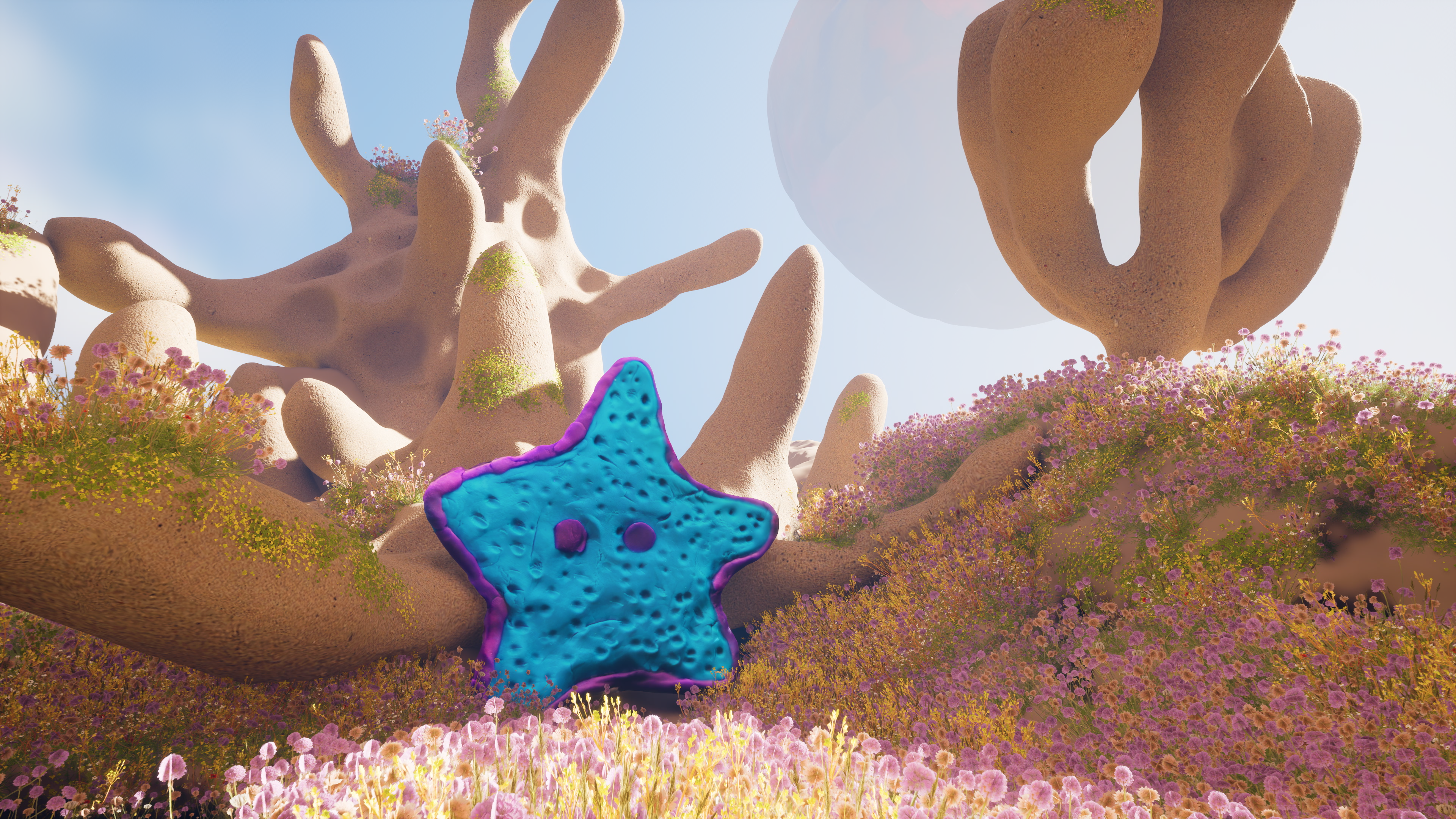
World-buildingThe environment for the monsters was also made out of 3D-scanned play-doh, modelled on top of the shape of a heart. The inspiration for this came from reading Brené Brown’s Atlas of the Heart — a book that gives us language for 87 different types of human emotions. In the current version of the project, you never really see the world from an aerial view, but it gave us a fantastic terrain to scan and use as a base for the world.

In our workshop, we were able to test our work-in-progress environment with the young participants, and asked them for their ideas on how we could build on this world. They wanted to see lots of plants, more ‘portals’, more cool stuff in the sky, and gave us ideas on where to place their monsters based on the emotions that their characters were embodying. These were all great ideas which informed the art direction and spatial design of the world.

Interactive Experience
The first outcome of the project that we developed was a prototype for an interactive experience built in Unreal Engine. Using a gamepad, one could navigate the environment and interact with different characters. When approached, each character would share the background stories that the participants had written for them.
Immersive Exhibit at FRAMELESS
As the project developed, an opportunity emerged to exhibit at FRAMELESS as part of the Imagined Realities residency in their Blank Canvas gallery.
FRAMELESS is the largest permanent multi-sensory experience in the UK, based in London. The huge canvas at FRAMELESS allowed visitors to stand directly inside the world of Moody Monsters and see the creations at larger-than-life size.
We think the impact of this project was that it gave children and young people a space to express themselves through making, and centred them as creators in a digital arts setting. It meant that younger visitors could connect to work made by other children and young people—as well as inviting adults see the world through the mind of a child.


Made at the Royal College of Art, 2024 by Ruby Bell and Riya Mahajan
Monsters by Abdurahman, Aisha, Alyssa, Daliya, Kiara, Raqeia, Rufta, Salmaan, Yahya
Music composition and Sound Design by Lian Dyogi
With thanks to Kensington Aldridge Academy and QPR Community Trust
Moody Monsters was exhibited at FRAMELESS as part of the Imagined Realities show from October 2024-March 2025.Shortlisted for the Helen Hamlyn Design Awards 2024
Official Selection, Spatial Storytelling at Breeze Film Festival 2024
Moody Monsters
Moody Monsters was a collaborative research project that explored the ways in which children and young people can build emotional literacy through narrative design and play.
Co-design WorkshopsWe developed a co-design workshop where young participants were supported to make their own characters based on different emotions, and taught to 3D scan their creations with Polycam.
We designed some prompts for the character and world-building activities like, ‘What is your monster good at?’, ‘What does your monster need help with?’, and ‘What world do you imagine your monster would live in?’ and we had some really lovely, earnest responses from participants.Each character was scanned by its inventor in our 3D scanning booth, to be placed in what we called a ‘digital sculpture garden’.
World-buildingThe environment for the monsters was also made out of 3D-scanned play-doh, modelled on top of the shape of a heart. The inspiration for this came from reading Brené Brown’s Atlas of the Heart — a book that gives us language for 87 different types of human emotions. In the current version of the project, you never really see the world from an aerial view, but it gave us a fantastic terrain to scan and use as a base for the world.
In our workshop, we were able to test our work-in-progress environment with the young participants, and asked them for their ideas on how we could build on this world. They wanted to see lots of plants, more ‘portals’, more cool stuff in the sky, and gave us ideas on where to place their monsters based on the emotions that their characters were embodying. These were all great ideas which informed the art direction and spatial design of the world.
Interactive Experience
The first outcome of the project that we developed was a prototype for an interactive experience built in Unreal Engine. Using a gamepad, one could navigate the environment and interact with different characters. When approached, each character would share the background stories that the participants had written for them.
Immersive Exhibit at FRAMELESS
As the project developed, an opportunity emerged to exhibit at FRAMELESS as part of the Imagined Realities residency in their Blank Canvas gallery.
FRAMELESS is the largest permanent multi-sensory experience in the UK, based in London. The huge canvas at FRAMELESS allowed visitors to stand directly inside the world of Moody Monsters and see the creations at larger-than-life size.
We think the impact of this project was that it gave children and young people a space to express themselves through making, and centred them as creators in a digital arts setting. It meant that younger visitors could connect to work made by other children and young people—as well as inviting adults see the world through the mind of a child.

Made at the Royal College of Art, 2024 by Ruby Bell and Riya Mahajan
Monsters by Abdurahman, Aisha, Alyssa, Daliya, Kiara, Raqeia, Rufta, Salmaan, Yahya
Music composition and Sound Design by Lian Dyogi
With thanks to Kensington Aldridge Academy and QPR Community Trust
Moody Monsters was exhibited at FRAMELESS as part of the Imagined Realities show from October 2024-March 2025.Shortlisted for the Helen Hamlyn Design Awards 2024
Official Selection, Spatial Storytelling at Breeze Film Festival 2024
Moody Monsters
Moody Monsters was a collaborative research project that explored the ways in which children and young people can build emotional literacy through narrative design and play.
Co-design WorkshopsWe developed a co-design workshop where young participants were supported to make their own characters based on different emotions, and taught to 3D scan their creations with Polycam.
We designed some prompts for the character and world-building activities like, ‘What is your monster good at?’, ‘What does your monster need help with?’, and ‘What world do you imagine your monster would live in?’ and we had some really lovely, earnest responses from participants.Each character was scanned by its inventor in our 3D scanning booth, to be placed in what we called a ‘digital sculpture garden’.
World-buildingThe environment for the monsters was also made out of 3D-scanned play-doh, modelled on top of the shape of a heart. The inspiration for this came from reading Brené Brown’s Atlas of the Heart — a book that gives us language for 87 different types of human emotions. In the current version of the project, you never really see the world from an aerial view, but it gave us a fantastic terrain to scan and use as a base for the world.
In our workshop, we were able to test our work-in-progress environment with the young participants, and asked them for their ideas on how we could build on this world. They wanted to see lots of plants, more ‘portals’, more cool stuff in the sky, and gave us ideas on where to place their monsters based on the emotions that their characters were embodying. These were all great ideas which informed the art direction and spatial design of the world.
Interactive Experience
The first outcome of the project that we developed was a prototype for an interactive experience built in Unreal Engine. Using a gamepad, one could navigate the environment and interact with different characters. When approached, each character would share the background stories that the participants had written for them.
Immersive Exhibit at FRAMELESS
As the project developed, an opportunity emerged to exhibit at FRAMELESS as part of the Imagined Realities residency in their Blank Canvas gallery.
FRAMELESS is the largest permanent multi-sensory experience in the UK, based in London. The huge canvas at FRAMELESS allowed visitors to stand directly inside the world of Moody Monsters and see the creations at larger-than-life size.
We think the impact of this project was that it gave children and young people a space to express themselves through making, and centred them as creators in a digital arts setting. It meant that younger visitors could connect to work made by other children and young people—as well as inviting adults see the world through the mind of a child.
Made at the Royal College of Art, 2024 by Ruby Bell and Riya Mahajan
Monsters by Abdurahman, Aisha, Alyssa, Daliya, Kiara, Raqeia, Rufta, Salmaan, Yahya
Music composition and Sound Design by Lian Dyogi
With thanks to Kensington Aldridge Academy and QPR Community Trust
Moody Monsters was exhibited at FRAMELESS as part of the Imagined Realities show from October 2024-March 2025.Shortlisted for the Helen Hamlyn Design Awards 2024
Official Selection, Spatial Storytelling at Breeze Film Festival 2024